SIM Swap Fraud in Pakistan: 7 Proven Ways to Protect Yourself Before It’s Too Late
SIM swap fraud is spreading fast across Pakistan. Here's how the scam works and the practical steps that keep your number and bank account safe.
SIM swap fraud in Pakistan has quietly become one of the most damaging forms of digital theft in the country. It doesn’t need your password. It doesn’t need you to click a suspicious link. All it needs is your mobile number, a bit of your personal information, and a cooperative or careless SIM retailer. Once a fraudster gets your number transferred to their SIM card, they can walk straight into your bank account, your mobile wallet, and every app tied to that number using OTP verification.
Pakistan’s rapid shift to mobile banking, Easypaisa, JazzCash, and app-based transactions has made this scam more profitable than ever for criminals. A single successful SIM swap can drain a person’s life savings within minutes, and by the time the victim realizes their phone has “no signal,” the money is already gone.
This guide breaks down exactly how SIM swap fraud works in Pakistan, why it’s becoming more common, and what you can do right now to protect yourself. We’ll also cover what to do if it’s already happened to you, and how PTA and telecom operators are trying to respond. Whether you’re a regular mobile banking user or just someone who wants to keep their identity safe, this article gives you the real, actionable steps that matter, not vague warnings you’ve already heard a hundred times.
What Is SIM Swap Fraud?
SIM swap fraud, sometimes called SIM hijacking or SIM jacking, is a type of identity theft where a criminal convinces your mobile network operator to transfer your phone number to a SIM card they control. Once that happens, your original SIM stops working, and every call, text, and one-time password (OTP) meant for you goes straight to the fraudster instead.
This is dangerous because so much of our digital identity is tied to our phone number. Banks, mobile wallets, email accounts, and social media platforms all use SMS-based verification as a security layer. If someone controls your number, they can reset passwords, approve transactions, and lock you out of your own accounts before you even notice something is wrong.
In Pakistan, this scam has grown alongside the popularity of branchless banking. According to the State Bank of Pakistan, mobile wallet transactions have grown by billions of rupees annually, which makes phone numbers an increasingly attractive target for organized fraud networks.
How SIM Swap Fraud Happens in Pakistan
Understanding the mechanics of this scam is the first step toward protecting yourself. Here’s the typical sequence fraudsters follow:
1. Information Gathering
Criminals first collect personal details about the target. This can come from:
- Leaked data from previous breaches
- Social media oversharing (birthdate, CNIC number, mother’s maiden name, etc.)
- Phishing calls pretending to be from a bank or telecom company
- Information bought from insiders at call centers or SIM retail shops
2. Approaching a SIM Retailer
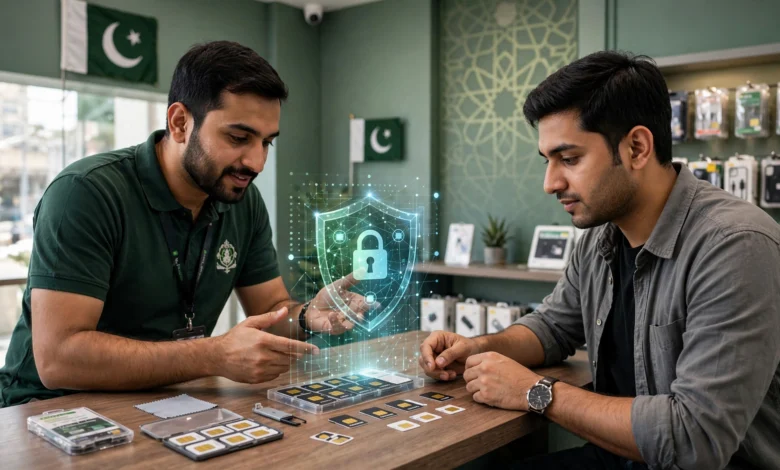
With enough personal information, or sometimes a fake or forged CNIC, the fraudster visits a mobile SIM point of sale (POS) and requests a SIM replacement, claiming their SIM was lost or damaged. In some documented cases, corrupt or careless retailers issue a duplicate SIM without properly verifying the customer’s biometric identity through NADRA’s Verisys system.

3. Number Takeover
Once the new SIM is activated, the victim’s original SIM is deactivated automatically. The victim usually notices this because their phone suddenly shows “No Service” or “Emergency Calls Only.”
4. Financial Exploitation
With the number now in their control, the fraudster requests OTPs for mobile banking apps, resets account passwords, and transfers money out of the victim’s bank account or mobile wallet within minutes.
This entire process, from information gathering to draining an account, can take as little as a few hours once the criminal has decided on a target.
Why SIM Swap Fraud Is Rising in Pakistan
There are a few specific reasons this type of fraud has picked up speed in recent years:
- Widespread mobile banking adoption: More Pakistanis than ever rely on JazzCash, Easypaisa, and bank apps, all of which use SMS OTP as a primary verification method.
- Weak retailer-level checks: Despite PTA regulations requiring biometric verification, some franchise outlets and small SIM shops don’t strictly enforce this, especially in less regulated markets.
- Data leaks and breaches: Several high-profile data breaches in Pakistan over the past few years have exposed CNIC numbers, phone numbers, and personal details, giving fraudsters raw material to work with.
- Low public awareness: Many people simply don’t know this type of fraud exists, so they don’t recognize the warning signs until it’s too late.
- Organized fraud networks: Reports from cybercrime wings of the FIA suggest that some SIM swap operations are run by organized groups with insiders at telecom retail points.
Warning Signs You’re a Target of SIM Swap Fraud
Recognizing the early signs of a SIM swap attack can save you from significant financial loss. Watch out for these red flags:
- Your phone suddenly loses network signal for no clear reason, even after restarting it
- You receive an SMS or call about a SIM replacement request you never made
- You get notifications about password reset attempts on your email, bank app, or social media
- You suddenly can’t log into your mobile banking app or wallet
- Friends or family mention receiving strange messages from your number
If you notice even one of these signs, treat it as an emergency. Every minute matters once your SIM has actually been swapped.
7 Proven Ways to Protect Yourself from SIM Swap Fraud
Here are the most effective, practical steps you can take to reduce your risk of falling victim to SIM swap fraud in Pakistan.
1. Set Up a SIM PIN and Retailer-Level Security
Most telecom operators in Pakistan, including Jazz, Zong, Telenor, and Ufone, allow you to set a secret PIN or password on your account that must be provided before any SIM replacement is processed. Call your operator’s helpline and ask specifically about this feature. It adds a manual verification step that a fraudster can’t easily bypass, even with your CNIC details.
2. Avoid Using SMS OTP as Your Only Security Layer
Wherever possible, switch to app-based authentication (like Google Authenticator) instead of SMS-based OTPs for your bank and email accounts. Many Pakistani banks now support app-based two-factor authentication (2FA) as an alternative. If SMS OTP is your only option, at least make sure it isn’t your only line of defense, pair it with a strong, unique password.
3. Limit Personal Information You Share Online
Your CNIC number, date of birth, mother’s name, and phone number are exactly what a fraudster needs to impersonate you. Avoid posting these details publicly on social media, and be cautious about sharing them over the phone with unknown callers, even if they claim to be from your bank or telecom provider.
4. Monitor Your SIM and Bank Account Activity Regularly
Check your mobile balance, SMS logs, and bank statements periodically. Many banks in Pakistan send free SMS or app alerts for every transaction; make sure these are turned on. Catching unusual activity early can be the difference between losing a small amount and losing everything.
5. Verify Before You Trust Any Call or Message
If you get a call claiming to be from your bank, telecom operator, or even the State Bank of Pakistan asking you to “verify” your CNIC or account details, hang up and call the official helpline number yourself. Legitimate institutions never ask for your PIN, OTP, or full CNIC over a call.
6. Use Strong, Unique Passwords for Financial Apps
Never reuse the same password across your email, mobile wallet, and banking apps. If one account gets compromised through a data leak, a unique password prevents the damage from spreading to your other accounts.
7. Register a Complaint Immediately If Something Feels Off
If your SIM suddenly stops working and you didn’t request a replacement, don’t wait. Visit the nearest franchise of your telecom operator immediately with your original CNIC to reactivate your number, and simultaneously contact your bank to freeze suspicious activity.
What to Do If You’ve Already Been a Victim
If you suspect you’ve already fallen victim to SIM swap fraud, act fast and follow these steps in order:
- Contact your telecom operator immediately and report the unauthorized SIM swap. Ask them to block the fraudulent SIM and restore your original number.
- Call your bank’s fraud helpline right away to freeze your account or card and stop any pending transactions.
- Change your passwords for email, social media, and any linked financial accounts from a different, secure device.
- File a complaint with the FIA Cyber Crime Wing, which handles digital fraud cases across Pakistan. You can find reporting details on the FIA Cyber Crime Wing’s official portal.
- Report the incident to the Pakistan Telecommunication Authority (PTA) if you believe a retailer issued a duplicate SIM without proper verification. PTA maintains a complaint mechanism for consumer protection issues, outlined on the PTA official website.
- Keep records of every call, message, and transaction related to the fraud. This documentation will be needed for both bank disputes and any legal complaint.
The faster you act, the better your chances of recovering funds and preventing further damage.
The Role of Telecom Operators and Regulators
To be fair, Pakistan’s telecom sector has taken some steps to curb this problem. PTA has mandated biometric verification for all new SIM issuances and replacements through NADRA’s Verisys system, which is supposed to make it much harder to fraudulently obtain a duplicate SIM. Major operators have also introduced SMS alerts whenever a SIM replacement request is made on an account.
That said, enforcement isn’t always consistent, particularly at smaller franchise outlets in less monitored areas. This is exactly why personal precautions still matter so much. Regulation reduces risk, but it doesn’t eliminate it, and the responsibility for staying safe still falls partly on the individual.
Frequently Asked Questions
Can SIM swap fraud happen without my CNIC?
It’s much harder, but not impossible, especially if a retailer skips proper biometric verification or if a fraudster uses a forged document. This is why biometric checks matter so much as a safeguard.
Does changing my SIM PIN protect me completely?
It significantly reduces your risk but isn’t a complete guarantee. Combine it with app-based authentication and cautious information sharing for the best protection.
How quickly can money be stolen after a SIM swap?
In many reported cases, victims lose funds within 30 minutes to a few hours of the SIM being swapped, which is why immediate action is critical.
Is SIM swap fraud illegal in Pakistan?
Yes. It falls under the Prevention of Electronic Crimes Act (PECA) 2016, and offenders can face criminal charges for identity theft and financial fraud.
Conclusion
SIM swap fraud in Pakistan is a serious and growing threat that exploits the trust we place in our phone numbers as a security checkpoint for banking and digital identity. It thrives on weak verification practices, oversharing personal information, and a general lack of public awareness. By setting up a SIM PIN, reducing your reliance on SMS OTP, guarding your personal details, monitoring your accounts, and knowing exactly what to do if something goes wrong, you can dramatically reduce your risk of becoming a victim. Fraud tactics will keep evolving, but staying informed and taking these practical precautions puts you in a much stronger position to protect your money and your identity.